Misted double glazing repair
Condensation between the panes means the seal has failed. We replace the glass and leave your frames alone.
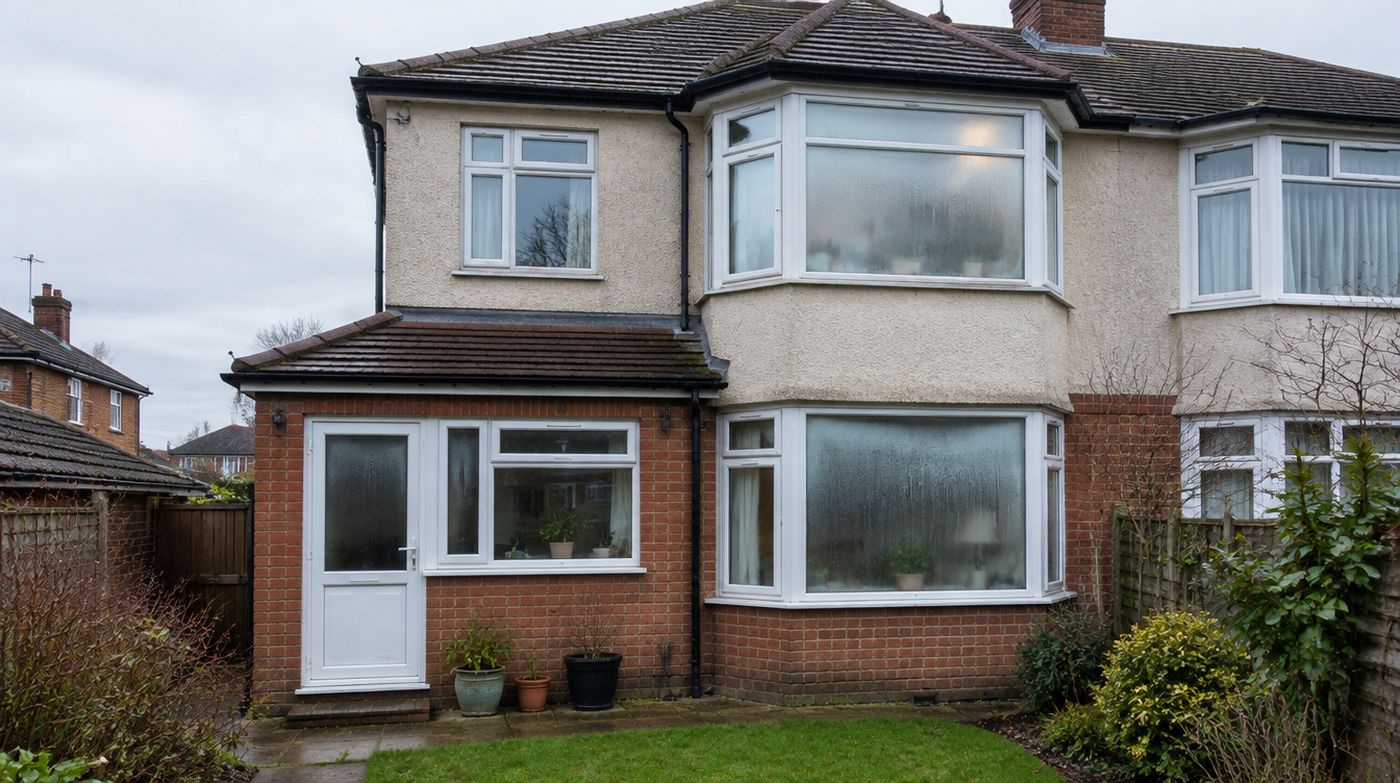
Misted double glazing repair is a glass job, not a window job. The failed sealed unit comes out, a new unit made to the exact size of your rebate goes in, and the frame, hinges, handles and locks all stay exactly where they are. We measure, we make the unit in our Wembley workshop, and we come back and fit it. For most of the misted and blown double glazing units we are called to across London, that is the beginning and the end of the work. Replacement glass units only, same frames, same windows.
Does misted double glazing repair mean drying out the old unit?
You will find people offering foggy window repair by drilling the glass, flushing the cavity with a solvent and fitting small vents. Treat it as a cosmetic trick, not a repair. The cavity of a working unit is a sealed, dried space. Once it is open to outside air it is a vented cavity for good: it will breathe moist air in on humid days and it will mist again, usually within a year or two. Any argon left in it has gone. Worse, if the unit has a soft coat low emissivity coating on one of the cavity faces, which nearly every unit made since the mid 1990s has, water that has already been sitting in there will have bloomed the coating, and the mineral etching left by standing water does not wash off at any price. You end up with a drilled, vented, stained unit and a bill for it. The glass is the consumable part of a double glazed window. Replace it.
How we measure replacement sealed units properly
A sealed unit has to be right in three directions, and the one people forget is thickness. We measure the width and height of the glass itself, not the frame opening, and we work from the sight size and the tight size so the finished unit sits in the rebate with the clearance it needs to be packed and to drain, rather than being wedged in. Then we measure the depth of the rebate and the thickness of the existing unit, because the new one has to fit under the same beads or behind the same putty line. A 1990s frame built around a 20mm or 24mm unit will not take a 28mm one, and the answer is not to force it. The answer is to get as much performance as possible inside the thickness you actually have.
We also check that the frame is square. Diagonals that differ by more than a few millimetres are common in bay windows on London clay and in older timber, and they change how a unit must be cut and packed. Shaped heads, curved bays, arched top lights and anything visibly out of square get templated rather than measured, because a shaped unit cut from written dimensions is a unit that comes back to the workshop.
Toughened glass cannot be cut, drilled or edge worked after it has been through the furnace. Every dimension has to be correct before it is toughened. That is the main reason the survey matters more than the fitting on this kind of work, and why we would rather send someone to measure than take sizes over the phone.
What goes into the new unit, and what is worth paying for
If you are replacing a 1990s unit of two clear panes and air, almost anything modern is an improvement. Some of the options are worth the money and some are not, so here is the honest order.
- A low emissivity coated inner pane. The single biggest improvement for the money. It reflects heat back into the room and runs warmer at the surface, which also reduces the condensation you get on the room side of the glass in winter.
- Argon in the cavity. Cheap, now standard, no reason to leave it out.
- A warm edge spacer. Reduces the cold band around the border of the glass, which is exactly where most people first notice condensation and mould on the reveal.
- Acoustic laminated glass. Genuinely worth it on a main road, a railway line or under a flight path. An asymmetric make-up, with one pane thicker than the other, does more for noise than simply making both panes thicker.
- Solar control glass. Useful on a south or west facing conservatory, a roof light or a large glazed extension that cooks in summer. On a north facing bedroom window it buys you a slight tint and nothing else.
- Obscure glass to a named pattern for bathrooms and front door side panels. Privacy levels vary far more between patterns than people expect, so pick by obscuration level, not by how it looks in a brochure.
What is rarely worth it in a retro-fit is triple glazing pushed into frames designed for double. Double glazed units made to measure at 24mm or 28mm are what those frames were built around, and the frame will not take the extra thickness or the weight, the sightlines change, and you will get more out of spending the same money on better double glazed units in more rooms. We will say so rather than take the order.
Is my frame actually the problem?
Sometimes it is, and you are owed a straight answer rather than a sale. We will not fit a new unit into a frame that is going to destroy it, because we would be back inside two years and so would the argument. These are the cases where the frame, not the glass, is the job.
- uPVC that has gone chalky and brittle, where the beads crack as they come off and the welded corners have opened up.
- Timber with soft dark rot in the bottom of the rebate, or at the joint where the sill meets the stile. A new edge seal sitting in a wet rebate fails early, every time.
- Frames so far out of square that the opener fouls the frame, which is usually building movement rather than a window fault, and needs dealing with first.
- Drainage slots blocked solid with silt and paint. That is repairable, and it is worth repairing at the same visit, because standing water is what killed the last unit.
- Steel frames of the 1930s Crittall type, where the original glazing was single and the rebate will take only a very slim unit, if anything at all.
A rotten timber rebate can often be cut out and spliced rather than the whole window being replaced. We would far rather do that and fit good glass. If the frame genuinely has to go, we will tell you at survey and you can go and get window quotations without having paid us for glass you cannot keep.
Where the law says you cannot use ordinary glass
Approved Document K sets out the critical locations where glazing has to be safety glass, or small enough, or protected. In practical terms that means glass in doors and in the panels beside them up to adult shoulder height, and low level glazing below roughly waist height in walls and partitions. In those positions the replacement unit needs toughened glass to BS EN 12150 or laminated glass to BS EN 14449, achieving BS 6206 Class A or equivalent impact performance, and it should carry a permanent mark in a corner of the pane so that anyone inspecting the house later can read it.
Where glazing also acts as a barrier at a drop, such as a full height window above a floor level change or a French door with no rail, BS 6180 barrier loading comes into it and the right answer is usually laminated rather than toughened, because laminated glass holds together and keeps containing the load after it breaks. If a quotation for a patio door side panel does not specify toughened or laminated, stop and ask why. That is not a detail, it is a requirement, and it applies to the person fitting the glass regardless of whether a new frame is involved.
Georgian bars, leaded lights and matching an existing pattern
Half the difficulty in matching older glazing is the detail inside it. Georgian bars that sit within the cavity come in different widths and profiles, flat or contoured, in white, cream, gold and brown, and the grid has to line up pane for pane with the unit next to it or the whole bay looks wrong. Bar spacing on a 1980s unit is rarely a round number, so we take the spacing off your existing unit rather than off a catalogue sheet.
Leaded designs that sit on the surface of the glass, applied as lead strip to both faces with a spacer pattern between, can be reproduced closely from a tracing of the existing pattern plus a photograph with a rule in it for scale. Genuine leaded lights, where individual pieces of glass are held in lead cames, are a different trade and can usually be kept rather than copied. The original panel is cleaned, re-cemented where it needs it, and encapsulated inside a new sealed unit, so it keeps its appearance and the house gains the insulation. In a conservation area that is normally the right answer, and it is the one a window salesman will not offer you.
Obscure glass is matched by pattern name. Patterns still in production are straightforward. A pattern discontinued twenty years ago may have no exact match at all, and we will tell you that and show you the nearest alternatives, rather than fitting something slightly different into one window of a bathroom and hoping you never look at the two side by side.
Landlords, letting agents and managing agents
If you look after more than one property you have two problems we can help with, and neither of them is the glass. The first is evidence. We will survey a property and hand you a schedule by room and by window, with sizes, make-up and safety glazing requirements written down, so you have a document you can get competing prices against and show to a tenant, a leaseholder or a freeholder. The second is sequencing. Units are priced as separate lines, so you can approve the failed ones now, hold the rest, and come back to them when the budget allows without paying for a second survey.
On energy performance, be realistic about what glass does. Replacing a failed air filled unit with a low emissivity argon unit genuinely improves the glazing element of an energy assessment, and on a property with a lot of glass it can help a borderline result. It is not a substitute for insulation, draughtproofing or heating measures, and glazing on its own rarely moves a band by itself. What matters practically is that an assessor records what they can see and evidence, so keep the invoice and the written specification, including the make-up and the installation date. Without paperwork, new glass in an old frame can be recorded less favourably than it deserves.
One more landlord point. A sealed unit that has failed is not a safety defect, and a tenant reporting misting is not reporting a hazard. Cracked glass in a door panel, or ordinary annealed glass in a critical location, is a different matter and should be dealt with promptly.
Trade supply and how to send us a cutting list
We supply sealed units to installers, builders, shopfitters and maintenance contractors across London. The orders that run smoothly are the ones where the cutting list arrives in a usable state, so here is what we want to see. A line per unit, numbered to match your own drawing or schedule. Width first, then height, in millimetres. The make-up spelled out in full. Toughening and lamination marked pane by pane rather than per unit, because outer toughened and inner annealed is a real and common specification. Spacer type and colour. Georgian bar layout with bar spacing, not just the number of panes. Pattern name and pattern orientation for obscure glass, and a note of which face is the outer face wherever the unit is not symmetrical.
Shapes need a template or a fully dimensioned drawing with radii, not a sketch. Tell us the delivery address, whether there is a lift, and the longest unit length that can physically get to the fixing point, because that decides how we crate and stillage the order.
Sizes are your responsibility on a trade order and we will make exactly what is on the list. If a size looks wrong against the others on the same job we will query it before cutting, but we cannot see your rebate from the workshop.
What happens on fitting day, and what happens to the old glass
Fitting takes much less time than people expect. The beads come out, the old unit comes out, the rebate is cleaned and checked for standing water and blocked drainage, the new unit is bedded on setting blocks so its weight is carried where the frame can take it, the beads go back and the drainage path is checked clear. Most domestic units are in and finished within half an hour. Nothing is cut inside your house. If a window is above ground floor level we will have established at survey whether it is internally or externally beaded, because that decides whether we can work from inside or need access outside.
Old units go back to the workshop. A sealed unit is awkward to recycle because it is glass bonded to a spacer, a desiccant and two different sealants, so the glass has to be separated from the edge assembly before a reprocessor will take it. We take them away, separate what can be separated, and send the glass on for reprocessing. What we will not do is leave them stacked against your side wall, which is how a great deal of glass ends up in London alleyways and front gardens.
Guarantees, and what they are actually worth
Most sealed unit guarantees run for five or ten years against seal failure, and most are worth less than the number on the certificate suggests. Read for three things. Who gives it, because a guarantee from a company that may not exist in eight years is a promise rather than a protection, and insurance backing is the only thing that changes that. What it covers, because a great many cover the supply of a replacement unit and not the labour to fit it, and on an upstairs window the labour is most of the cost. And what voids it, because installation into a frame with blocked drainage, or into a frame the installer has already flagged as unsuitable, is excluded in almost every set of terms written. Ask for the written terms before you pay a deposit, not after.
FAQ
Questions we get asked
Why has my double glazing gone misty?
A sealed unit is two panes bonded to a spacer bar with a desiccant inside to absorb the small amount of trapped moisture. When the perimeter seal fails, outside air gets in, the desiccant saturates, and moisture then condenses on the inner faces of the glass where you cannot reach it. That is what the haze and the water droplets are. The glass is sound and the frame is usually fine — the seal has gone.
Can misted double glazing be cleaned or repaired?
No. Drilling and 'de-misting' a unit is sometimes offered and we would not recommend it: the cavity is vented to the outside air, so the window stays permanently open to moisture, the coating and desiccant are already compromised, and the thermal performance does not come back. The unit has to be replaced. The good news is you only replace the glass.
How much does a replacement sealed unit cost?
It depends on size, glass build and whether toughened or patterned glass is needed, but it is a small fraction of replacing the window. Replacing several units on the same visit is cheaper per unit than calling someone out for one, because most of the cost of a single unit is the visit. We quote in writing per unit, fitting and disposal included.
Do I need new windows instead?
Only if the frames are the problem. If a uPVC frame is distorted, the hinges are shot or a timber frame is rotten, new windows make sense. If the frame is sound and only the glass has misted — which is the usual case — replacing the unit is the right repair, and anyone telling you a misted pane means a new window is selling you a window.
How long does it take?
Measuring takes a few minutes. Plain units are usually ready within a few days, patterned and toughened a little longer, and fitting takes roughly 20 to 30 minutes per window. Most jobs are finished within a week of the first visit.
Can you match patterned or leaded glass?
Usually, yes. Obscure patterns like Stippolyte, Cotswold and Satin are still in production and we keep the common ones. Leaded and Georgian bar units can be made to match the adjacent windows. Older discontinued patterns are the exception — we bring samples to compare rather than guess from a photograph.
Get a price for your replacement units
Tell us roughly how many windows have misted and we will give you a price. Several units on one visit works out cheaper per window.