Blown double glazing units: what has actually failed
Blown, misted, gone, steamed up. They all describe one event, and none of them are the frame’s fault. This is what happens inside a sealed unit when it goes, and what each stage looks like from your side of the glass.
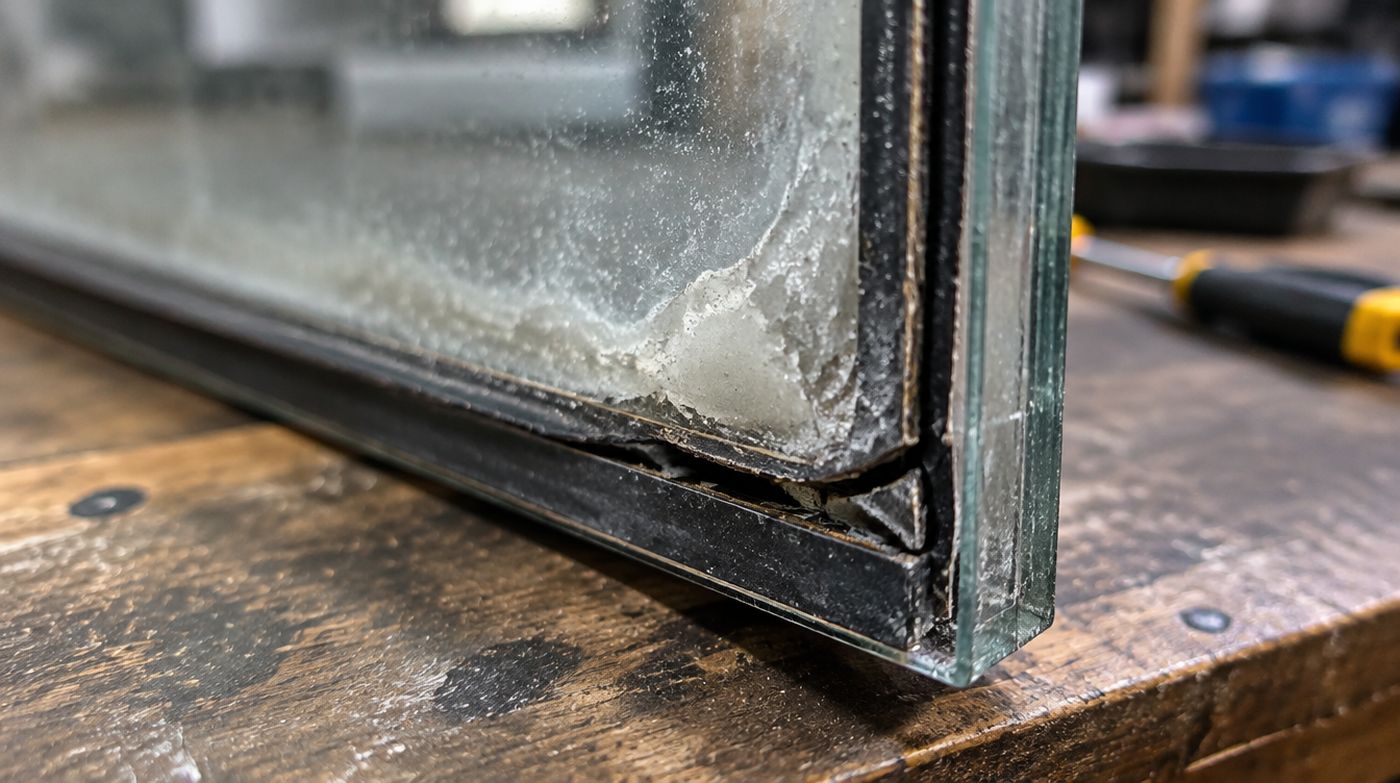
What people mean by blown double glazing units
Blown double glazing units are units whose edge seal has failed, so the sealed cavity is no longer sealed. The word has nothing to do with anything bursting. It is trade shorthand and it means gone, finished, no longer holding. You will hear the same window called blown, misted, failed, steamed up or gone cloudy, and they all describe the same thing: the barrier round the perimeter of the glass has let go, and outside air carrying moisture now moves in and out of the cavity.
Nothing about that failure involves the frame, the hinges, the locks or the installation of the window. That is why a blown unit is a glass job and not a window job. What is worth understanding is how the seal is built, because then the failure makes sense and you can judge how far along yours is.
How a sealed unit actually fails
A sealed unit is two panes of glass held apart by a spacer bar running round the perimeter. Inside that spacer there is desiccant, a drying agent that mops up the small amount of moisture sealed in during manufacture. The spacer is bonded to both panes by a primary seal, usually a thin line of polyisobutylene, and that is the part that genuinely stops water vapour. Outside it, filling the channel between the two panes, is a secondary seal of polysulphide, polyurethane or hot-melt, which holds the sandwich together mechanically.
Every day the air in that cavity is warmed by the sun and cooled again at night. It expands and contracts, and the glass flexes very slightly in and out with it. Over years that cycle works the seals the way bending a paperclip repeatedly works the metal. The primary seal is a vapour barrier, not a structural one, so once the secondary seal loses its grip at a corner or along an edge, the primary seal is being stretched and squeezed with nothing supporting it.
When it finally lets go, the cavity breathes. Warm damp air gets in. The desiccant absorbs it, and goes on absorbing it until it is saturated, which can take months or years. That is why a unit usually fails silently long before anything is visible. After saturation, the first cold night that takes the cavity below its dew point puts water on the inner face of the outer pane, and you see it. Most people think the unit broke that morning. It broke a long time earlier.
Argon loss happens through the same breach, at the same time, and it is the invisible half of the problem. A unit can be out of gas and performing like plain air-filled glass well before it ever mists.
The four stages of failure, and what each one looks like
Stage one: nothing to see
The seal has gone and the desiccant is still coping. There is no visible sign whatsoever. The only tell is a window that feels colder than its neighbours on the same elevation, because the gas fill has already escaped.
Stage two: mist that comes and goes
A film in the bottom corners or along the bottom edge on cold mornings, gone by the middle of the day. The glass itself is still clean and the cure is simply a new unit. If you are going to do anything about the window, this is the cheapest moment to do it, because nothing is permanently marked yet.
Stage three: permanent haze and running water
Mist that no longer clears, droplets that run and leave tracks down the pane, and in some units a visible pool at the bottom of the cavity after heavy rain. The low-emissivity coating on the cavity face is now being wetted and dried on a daily cycle and it begins to break down, which shows as a dull, slightly oily iridescence rather than clean water.
Stage four: staining and etching
Water held against glass for years leaves mineral deposits and eventually etches the surface. Those marks are in the glass, not on it. At that point nothing anybody does makes that pane clear again, and no cleaning or polishing service can help, which is worth knowing before somebody offers to try for a fee.
A blown unit is a consumable part reaching the end of its life. It is not evidence that your windows need replacing, and a company that treats it as evidence is selling you the wrong thing.
There is no stage at which a blown unit repairs itself and no stage at which it stops getting slowly worse. There is also no stage at which it becomes dangerous, so a unit at stage two does not need dealing with this week. Put it on the list and do it with the others.
How long should a double glazed unit last?
Guarantees on sealed units in this country are commonly five or ten years, which tells you what the industry expects rather than what you should expect. A well-made unit, properly installed in a drained and ventilated rebate on a sheltered elevation, routinely lasts twenty years and often longer. The identical unit on a south-west facing bay with blocked drainage can fail in five.
So the honest answer is that the unit is a wearing part whose life depends far more on where it sits and how it was fitted than on whose name is on it. That is also why we will not promise you thirty years, and why you should be sceptical of anybody who does. The sealant chemistry has improved. The physics of thermal cycling has not changed at all.
What makes blown double glazing units fail early
Four things account for most of the early failures we see across London, and three of them are about fitting rather than glass.
Standing water is the big one. If the bottom of the glazing rebate does not drain, the secondary seal sits in water permanently. Polysulphide tolerates damp. It does not tolerate immersion. Clearing the drainage slots on the frames you already have is free, takes ten minutes with a thin screwdriver, and does more for the life of your next unit than any upgrade you can buy.
Heat is second. South and west elevations, conservatory roofs and anything glazed above a radiator run hotter and cycle harder. So does any unit sitting behind a closed blind or a heavy lined curtain in summer, because the trapped air behind the blind can reach temperatures the sealant was never designed for. If you have a unit that bakes behind a blind, lifting the blind on hot afternoons genuinely extends its life.
Bad bedding is third. A unit should sit on setting blocks, not on the frame and not on the bead, and in a drained system it should not be bedded solidly in silicone. Units forced into an opening, or packed at one corner only, carry load through the glass edge, and that works the seal from the first day.
Size and shape is fourth. Large units, tall narrow ones, stepped units and anything shaped flex more and fail sooner than a small square pane. That is physics rather than workmanship, and it is why the big bay often goes years before the small bedroom lights in the same house.
Blown units that turn out not to be blown
Before you spend anything, rule out the things that look identical from across the room. We get called out to all of these and we would rather you checked first.
Condensation on the room side of the glass wipes off. If your cloth clears it, the unit is intact and you have a humidity and ventilation question instead. Condensation on the outside face, usually on cold clear mornings on good modern glass, also wipes off, and it is actually a sign the unit is working: the outer pane is staying cold because heat is not leaking through it.
A hazy, faintly rainbow sheen on glass that is otherwise dry is often the low-emissivity coating or toughening distortion rather than a failure. Hold a phone torch at a shallow angle to the glass in a dark room and count the reflections. Four reflections means two panes, and if one of them is a slightly different colour there is a coating on that face, so the unit is modern and intact.
Scratches, cement splashes and old cleaning marks sit on an outer surface and can be felt with a fingernail. Nothing inside a sealed cavity can be felt from outside. So if you can feel it, it is not a failed seal, and it is not a unit you need to buy.
And do not let anybody sell you glass for a window whose only real fault is a draught. Draughts come from gaskets, hardware and the joint between frame and wall. A new unit will not change them by a noticeable amount, and we have walked away from jobs where that turned out to be the actual complaint.
Replacing a blown unit, and what we make it out of
We make replacement units in our own workshop in Wembley, which means we cut, edge, polish, toughen where the location requires it and assemble the unit ourselves. In practice that matters in three ways. We can match an unusual overall thickness instead of persuading you into a standard one that nearly fits. We can pattern-match obscure glass by holding samples against yours rather than against a brochure. And if a size needs remaking, it is days rather than weeks.
Where blown double glazing units sit in a door, a side panel beside a door, or low-level glazing below 800mm from the floor, the replacement has to be safety glass under Approved Document K, to BS 6206 Class A, whether the pane there now is or not. We check that on survey, because ordinary float glass in a door is something we find more often than we should.
We cover Greater London, strongest across the north, west and central boroughs, we survey free and we quote in writing with each unit listed by room and size. Hours are Monday to Friday, 8am to 5pm, on 020 4634 6045. If you have several failed units, say so when you call, because one visit for all of them is substantially cheaper for you and it is how we would rather do the work.
FAQ
Questions about blown double glazing units
Is a blown double glazed unit dangerous?
No. The seal failing does not weaken the glass. Both panes are still whole, still held in by the beads, and there is no risk of the unit falling out or shattering because the cavity has lost its seal. The only safety question is a separate one. If the window is in a critical location under Approved Document K, which means a door, a panel beside a door, or glazing below 800mm from floor level, the glass has to be safety glass. We occasionally find ordinary float glass in those positions, and that does need putting right regardless of whether it has misted.
Can one pane of a blown unit be replaced instead of the whole unit?
Not in normal production. A sealed unit is a bonded assembly, and splitting it destroys the seals and the desiccant, so the labour of taking one apart and rebuilding it costs more than cutting fresh glass. There is one exception worth asking about. Where a unit contains something irreplaceable, such as a genuine old leaded panel or a patterned glass no longer manufactured, we can sometimes build a new unit around that salvaged pane. Expect it to cost more than a straightforward new unit rather than less, and expect us to be honest about the risk of breaking it.
Does one blown unit mean the rest of my windows will fail too?
Not necessarily, but it is a fair prompt to look. Units in one house are usually the same age and the same make, so they share a service life, and the ones on the hottest and most exposed elevation go first. That does not mean the sheltered north-facing units are near the end of theirs. Check each window on a cold morning before deciding anything. Replacing sound units simply because they are the same age as a failed one is money spent years early for no benefit. Do the failed ones, clear the drainage on the rest, and look again next winter.
Get a price for your replacement units
Tell us roughly how many windows have misted and we will give you a price. Several units on one visit works out cheaper per window.