Condensation between the glass panes: how to check, and what it means
You have spotted mist inside the glass where no cloth will reach it. Before anybody quotes you, there are three checks worth doing yourself and some weather behaviour worth understanding.
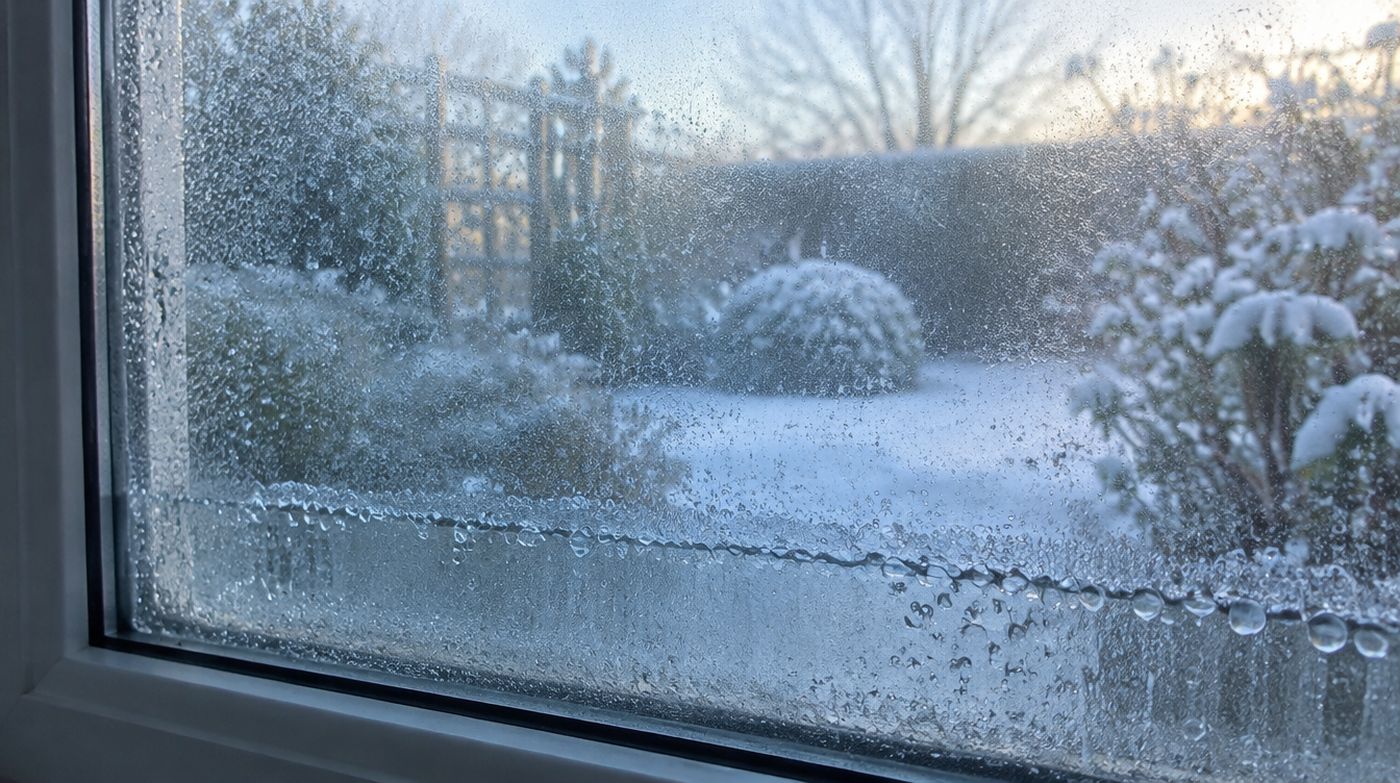
How to tell that condensation between glass panes is inside the unit
Condensation between glass panes is the one kind you cannot reach, and that is the test. Wipe the inside face with a dry cloth. Go outside and wipe the outside face. If both faces come up dry and the mist is still there, the water is inside the sealed cavity and the edge seal of that unit has failed. Nothing else puts water in that position.
Two further checks take a minute each, and they tell you what the glass is as well as whether it has gone.
The torch test
In a dark room, hold a torch or a phone light at a shallow angle to the glass and look at the line of reflections. A double glazed unit gives four reflections, one from each glass surface. If one of those four is a slightly different colour, usually a little pink or green, there is a low-emissivity coating on that face, which tells you the unit is reasonably modern and worth replacing like for like. Two reflections only means a single sheet, so you have secondary or single glazing and a different problem.
The fingernail test
Run a fingernail across the mark. Scratches, paint flecks, cement splashes and limescale run-off from a leaking gutter all sit on an outer surface and can be felt. Nothing inside a cavity can be felt from outside. This matters, because builders’ marks and coating damage get mistaken for a failed unit every week, and a window you can clean is a window you do not need to buy glass for.
One more thing to rule out. Condensation on the outside of the glass on cold clear mornings looks alarming, but it is a sign of a good unit: the outer pane is staying cold because heat is not leaking out through it. It wipes off, and nobody should be quoting you for it.
Why it appears at dawn and clears by lunchtime
A failed unit mists when the cavity faces of the glass fall below the dew point of the air trapped in the cavity. Both of those figures move through the day, which is why the problem looks intermittent.
Overnight the outer pane radiates heat to a cold sky and the cavity cools. By dawn the glass surfaces are at their coldest and the moisture in the cavity air condenses onto them, starting in the bottom corners because that is where the glass is coldest and where any standing water already sits. As the sun comes round and warms the glass, the water evaporates back into the cavity air and the mist vanishes. Nothing has been cured. The water has simply changed state and is still in there.
That daily cycle is why somebody looking at two in the afternoon on a sunny day can honestly say they see nothing wrong. Photograph the window at eight in the morning and keep the picture. It saves an argument with a surveyor, a landlord or a managing agent.
The same mechanism explains the pattern across a house. North-facing windows mist first and stay misted longest, because they get no early sun to clear them. Windows behind closed blinds and heavy lined curtains also stay misted, because the cavity is shaded from the warmth that would dry it. So the windows that look worst are not necessarily the ones that failed first.
Why spring and autumn are worse than the middle of winter
Most people expect the worst of this in January, and are then surprised that their windows look clearer in a cold snap than they did in October.
Two things drive that. The first is the size of the daily temperature swing. Clear nights in spring and autumn give big falls between afternoon and dawn, which is exactly what takes the glass below the dew point. A settled cold week in midwinter, often under cloud, has a smaller swing. The second is absolute humidity: air in October is carrying far more water than air in January, so each time a failed cavity breathes it takes in more moisture.
A failed unit also breathes with a pressure cycle, not only a temperature one, so a windy, wet autumn week loads the cavity with water far faster than a still, dry cold one. A unit that looked acceptable in February and dreadful in April has not deteriorated. It has had a wetter month.
Does condensation between glass panes mean the house has a damp problem?
Short answer, no. This is worth being clear about, because people spend real money in the wrong place on the back of it.
Condensation between glass panes is water that came in through a failed factory seal from the outside. It has nothing to do with the humidity in your rooms, your ventilation, drying laundry indoors, or any damp in the structure. A house with perfect ventilation and a dehumidifier in every room will still show misting in a unit whose seal has gone.
Water inside the glass is a failed component. Water on the glass is a conversation about the house. They look similar from the sofa and they cost very different amounts to put right.
The kind that does tell you something about the house is the kind on the room side of the glass, the kind that wipes off. That one is warm moist indoor air meeting a cold surface, and the cures are ventilation, heating and, where the glass is the coldest surface in the room, better glazing. If you have both kinds, deal with them separately. Replacing sealed units will not noticeably reduce the condensation you can wipe off, and we will tell you that rather than let you expect it and be disappointed.
What a failed unit does affect is the window’s insulation, and that has one knock-on. A window that has lost its gas fill runs colder on the room side, so the wipeable condensation on that particular window may genuinely increase, and with it the risk of mould on the frame and the plastered reveal. So the two are linked at one end. The water inside the glass is still not evidence of a damp house.
What it is costing you while you leave it
A sealed unit keeps weather out, reduces heat loss, and in most modern units takes a little noise off. Only the heat loss is affected when the seal fails, but it is affected immediately and invisibly.
The gas fill escapes through the same breach the water comes in through, so the cavity goes from argon to air, and air moves heat more readily. Then the low-emissivity coating, which does most of the real work in a modern unit by reflecting warmth back into the room, starts to degrade where it is repeatedly wetted. Once that coating has clouded it has stopped reflecting, and the window is performing much like plain glass in a frame.
Replacement glazing has to meet the thermal requirement in Approved Document L, and a current unit with a soft-coat low-emissivity pane, a warm-edge spacer and an argon fill does that comfortably. A failed thirty-year-old unit with a plain aluminium spacer and no coating never did. So replacing a failed unit in an older window is usually an upgrade rather than merely a repair, which is one of the few genuinely cheerful facts in this subject.
What is not worth doing is replacing the sound units elsewhere in the house at the same time for the sake of consistency. The gain is small, the cost is not, and the units you have are still doing their job. Replace what has failed.
The point where waiting starts to cost you more
There is a real deadline here and it is not a sales one.
While the cavity faces are simply wet, the only cost of waiting is performance. Once water has sat against the glass through enough cycles it leaves mineral deposits, and eventually it etches the surface. Etched glass cannot be cleaned, polished or recovered. That does not change what you pay for the new unit, because the whole unit is replaced either way. What it changes is your option to do nothing: a lightly misted unit still looks acceptable from across a room, and a stained one does not, so you lose the ability to postpone.
It matters more on units that are hard to match. Patterned glass no longer in production, genuine leaded panels and sealed-in Georgian bars in unusual widths all get harder to match as the years pass, because patterns get discontinued. If a failed unit is one of those, bring it forward, because the glass you need to match against is coming off a shrinking list.
Otherwise, condensation between glass panes is not an emergency. It is not a safety issue, it will not leak into the room, and it cannot get wetter than wet. Anybody telling you it must be dealt with this week is selling, not surveying.
Which windows to deal with now, and which can wait
Grouping the work is the practical decision for most households, and it is the one place a little patience saves money. A fitter already on site with the beads off is a much cheaper way to replace a second unit than a separate visit a month later, so go round every window once, properly, before ordering anything.
Do it on a cold morning before the sun has been on the glass. Open each window, look along the bottom corners, and note the room, which pane it is in a bay or a French door, and whether the mist clears. Include anything only slightly hazy: those will be obvious next year, and adding them to the same order costs a fraction of calling somebody back.
Deal first with anything in a door or a panel beside a door, because those are critical locations where the replacement must be safety glass under Approved Document K, and it is better to find an ordinary float pane in a door now than later. Then the rooms you actually look out of. A bedroom window behind closed curtains can usually wait until you have another reason for somebody to come.
Then call us before you order anything. The survey is free across Greater London, we measure each unit to the rebate ourselves and we quote in writing with every unit listed by room and size. We make the units at 6 Atlas Road in Wembley, which is why we can match odd thicknesses and old patterns instead of talking you into a standard unit, and why we would rather make glass for the frames you have than sell you new windows. Monday to Friday, 8am to 5pm, on 020 4634 6045.
FAQ
Questions about condensation between glass panes
Why does the condensation between my panes come and go?
Because it is driven by temperature, not by anything you are doing in the house. Overnight the glass cools, the air trapped in the failed cavity drops below its dew point, and water condenses on the cavity faces, worst in the bottom corners. When the sun warms the glass, that water evaporates back into the cavity air and the mist disappears. None of it has left the unit. This is also why a window can look perfect to a surveyor at midday, so photograph it early in the morning and keep the picture for whoever you are dealing with.
Does condensation between the panes cause mould?
Mould needs a damp surface it can colonise, and the inside faces of a sealed unit are shut away from your rooms, so you will not get mould where you can see the mist. The indirect risk is real though. A unit that has lost its gas fill and its coating runs colder on the room side, so that window becomes the coldest surface in the room and attracts the condensation you can wipe off. Left on a timber frame or a plastered reveal through a winter, that water does grow mould, on the frame and reveal rather than in the glass. If one window in a room is mouldy and the others are not, check whether its unit has gone.
Is condensation between glass panes covered by a window guarantee?
Sometimes, and it is worth checking before you pay anybody. Sealed units are commonly guaranteed against seal failure for five or ten years from installation, usually by the window company that supplied them rather than by whoever made the glass. If your windows are still inside that period, find the original paperwork and go back to the installer first. The things that typically void it are drilling or venting the unit, resealing round the glass with silicone, and any alteration by a third party, which is a good reason not to let anybody treat the glass in place while a claim is still possible.
Get a price for your replacement units
Tell us roughly how many windows have misted and we will give you a price. Several units on one visit works out cheaper per window.