Cheap sealed unit replacement, done honestly
There are real ways to spend less on replacing a failed unit, and there are quotes that are low because something has been left out of them. This page is about telling the two apart, including the specification we think you can safely drop.
What makes a cheap sealed unit replacement legitimately cheap
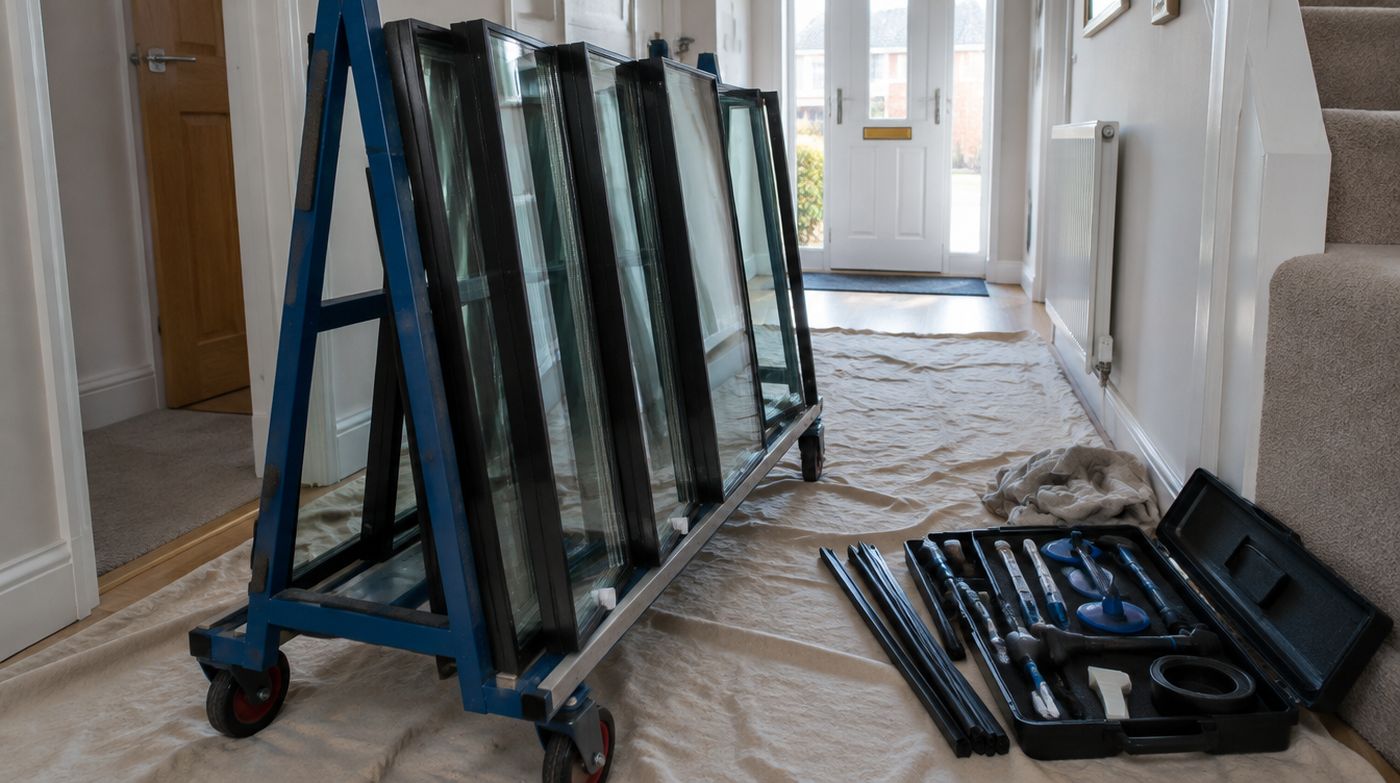
A cheap sealed unit replacement is not a different product. It is the same unit with cost taken out of how it is specified, handled and fitted, and there are only a handful of places that cost genuinely lives. Knowing where they are lets you ask for a lower price without ending up with worse glass.
The first is the glass make-up, which has the next section to itself because that is where most of the avoidable money sits. The second is handling: how many times somebody drives to your house, and how long they spend on a tower rather than standing on your carpet. The third is the glass being plain rather than processed. A square clear unit is cut, assembled and sealed in minutes, whereas toughening, laminating, patterned glass, leaded work and sealed-in bars all add process steps and sometimes a second supplier.
Fourth, honestly, is doing several units in one visit rather than one at a time. That is the biggest single lever most households have and we have written about it elsewhere on this site, so it gets a sentence here rather than a section.
A cheap quote and a cheap job are not the same thing. One is a company that has worked out how to do this efficiently. The other is a company that has worked out what you are unlikely to check.
Specification you may be paying for and probably do not need
This is where we talk customers out of money, and we do it most weeks.
Toughened glass is the big one. It is a legal requirement in critical locations under Approved Document K: doors, the panels beside doors, and glazing below 800mm from floor level in a window. It is not a general upgrade, and in a first-floor bedroom window with a cill at waist height it buys you nothing except a bigger bill. If a quotation has toughened glass across every unit in the house, ask which locations require it and why, and expect a specific answer for each window rather than a company policy.
Acoustic laminate is second. It works, noticeably, on a window facing a bus route, a railway or a main road. On a back bedroom over a garden it is money for nothing. Specify it where the noise actually is and plain glass everywhere else, even if that makes the quotation look inconsistent.
Solar control glass is third. It earns its place on a south or west facing room that overheats, a conservatory roof or a large glazed elevation. On a north-facing window there is no solar gain to control, and the tint costs you daylight you want in a London terrace.
Triple glazing is fourth, and in existing frames it is often not even possible. Most frames have a rebate depth suited to a 20mm, 24mm or 28mm unit, and a triple unit needs more than that. If somebody offers triple glass in the frames you already have, ask what the rebate depth is before you discuss price.
What you should not cut is the other half of this. A soft-coat low-emissivity pane, a warm-edge spacer and a gas fill are not luxuries. They are roughly what replacement glazing is expected to be under Approved Document L, and on a small unit the combined cost of them is modest. A quote that is cheap because it is plain float glass in a clear-glazed window is not a bargain, it is below standard.
The three things that have no cheap version
Measuring has to be done properly, with a bead off or by somebody who knows the system, because a sealed unit cannot be trimmed afterwards. A price given over the phone from sizes you read off the visible glass is a price for a unit that will not fit.
Safety glass where the law requires it is not negotiable, and it is also the item most often quietly omitted to hit a number. If a door panel is quoted at the same rate per square metre as a landing window, something is wrong with one of those two figures.
Proper bedding costs minutes rather than pounds, but those minutes are exactly what a rushed fitter skips. Setting blocks, side packers, a rebate left able to drain and beads refitted in the right order are the difference between a unit that lasts twenty years and one that mists again in four. There is no saving available here, only a cost deferred.
Where a suspiciously low quote is cheap because something is missing
When a quotation for a cheap sealed unit replacement comes in far below the others, it is usually one of the following, and every one of them is fair to ask about directly.
Float glass instead of low-emissivity, which is cheaper per square metre and leaves you a window performing like 1985. You can often spot it afterwards: shine a torch at the glass at a shallow angle in a dark room and a coated unit shows one of its four reflections in a slightly different colour.
Air instead of argon, which is invisible and effectively unverifiable once the unit is made, which is precisely why it gets left out. Ask for the make-up to be written on the quotation.
An aluminium spacer instead of a warm-edge one, which saves a little and gives you cold glass edges and a line of condensation along the bottom of the pane every winter.
Ordinary glass in a critical location, which is the serious one, because nobody tells you that is what they have done and you will not know unless you look for the stamp.
Nothing allowed for making good, so when a bead breaks on removal or a gasket is past reuse it becomes an extra on the day, at a price you never agreed.
And no written specification at all, just a number. A quotation that does not list each unit by room, size, overall thickness and glass type is not something you can hold anybody to later.
Be careful, too, with a low price offered for de-misting the existing glass rather than replacing it. That is a different job with a worse outcome, which we cover properly on our foggy window repair page. It is the cheapest thing in this trade and we will not do it at any price.
Access, parking and why the same unit costs more in some streets
Two identical units, same size, same make-up, can carry different prices because of the street they are in. That is legitimate, and it is also fair to ask for it to be explained.
A ground-floor window reached from inside is the cheapest case. A first-floor window over a flat roof is next. A second-floor window on a terraced street with no side access and no rear gate needs a tower pitched out front, and in a permit bay or on a red route that means a parking suspension or a dispensation from the borough, plus the time to arrange it. In parts of Camden, Islington, Westminster and Kensington that administration is a real part of the day and somebody has to pay for it.
Mansion blocks have their own version. Many require notice to the managing agent, restrict working hours, ban the passenger lift for materials or want a goods lift booked, and some ask for evidence of insurance before anybody comes through the front door. None of it is difficult, but it takes a slot in a diary and it should be priced openly rather than appear as a surcharge afterwards.
There is a way to make this part cheaper and it is in your hands. Tell whoever quotes, before they visit, how the window is reached, whether there is access to the back, whether the street is a permit bay and what rules the block has. A surveyor who knows all that can price the job in one pass, and an accurate quote is usually lower than a hedged one.
Why the second visit is where cheap jobs fall apart
Replacing a sealed unit is a two-visit job: measure, then fit. The cheapest operators save their money on the first visit, which is exactly why the second one goes wrong.
If nobody takes a bead off, nobody knows what the glazing system is, whether those beads are still manufactured, whether the unit is 20mm or 24mm, whether the rebate drains, or whether the pane in the door is toughened. All of that then arrives on fitting day with the glass already made. At that point you get offered a compromise: a unit that nearly fits, silicone where setting blocks should be, or a return visit you pay for.
We would rather spend twenty minutes surveying, and the honest commercial reason is that a remake costs us more than a survey does. The useful question for you to ask anybody quoting cheaply is simply whether somebody will remove a bead and measure the opening before the glass is made. If the answer is no, that is not really a price. It is an opening bid.
The cheapest version of this job we would put our name to
For a typical London job that is a clear unit at the overall thickness the frame actually takes, with one soft-coat low-emissivity pane, a warm-edge spacer and an argon fill, plain glass wherever the location allows it and toughened only where Approved Document K requires it, fitted on setting blocks in a rebate left free to drain, with existing gaskets reused if they are still soft and replaced if they are not.
That is not a budget unit. It is the standard unit with the optional extras left off. Most of what makes sealed units expensive is specification nobody checked you needed, and most of what makes them fail early is fitting nobody watched.
We make them in our own workshop at 6 Atlas Road in Wembley, which keeps a layer of margin out of the price and means a remake takes days rather than weeks. The survey is free across Greater London, the quotation is written and fixed with each unit listed by room, size and make-up, and the fitting is done by our own teams rather than subcontractors. If the cheapest answer for you is to measure and fit yourself, we will supply glass only and tell you plainly who then carries the risk on the sizes.
Monday to Friday, 8am to 5pm, on 020 4634 6045. If your window does not need what somebody has quoted you for, you will hear that on the phone.
FAQ
Questions about cheap sealed unit replacement
Why are sealed unit prices so different between companies?
Usually because they are not quoting the same unit. Price per square metre varies with the glass make-up, whether a pane is toughened or laminated, whether the spacer is warm-edge or aluminium, whether the cavity is gas filled, and whether a pattern has to be matched. On top of that sits access: a ground-floor window glazed from inside and a second-floor window needing a tower and a parking suspension are different jobs. Ask every company to write the make-up and the access arrangement on the quotation, then the comparison becomes possible. A single figure with no specification tells you nothing.
Is the cheapest sealed unit quote ever the right one?
Often, yes, and we say that as a company that has lost jobs on price. A firm with its own cutting and sealing plant, a van already working in your postcode and no showroom to fund can be genuinely cheaper on the same specification. What makes a low quote wrong is not the number, it is an omission: float glass where low-emissivity belongs, ordinary glass in a door, no allowance for broken beads, or no measuring visit at all. Check the specification rather than the price, and the cheapest quote is often the one that survives the check.
Can I save money by replacing sealed units myself?
You can save the fitting labour, and for one accessible window that can be worthwhile. The saving disappears the moment a size is wrong, because sealed units are made to order and cannot be altered or returned, so a remake is at your cost. It also disappears if the unit is large, above the first floor, in a door, or in a frame whose beads are obsolete and may snap on removal. We supply glass only where it makes sense, and we will tell you when it does not rather than take the order anyway.
Get a price for your replacement units
Tell us roughly how many windows have misted and we will give you a price. Several units on one visit works out cheaper per window.