Areas we cover across London
We work from our workshop at 6 Atlas Road, Wembley HA9 0JH, across Greater London and the near Hertfordshire border.
Core coverage
Where most of our work is
Being based in Wembley means north, west and central London are on our doorstep. These are the areas we are in most weeks.
- Wembley
- Harrow
- Brent
- Ealing
- Camden
- Westminster
- Kensington & Chelsea
- Hammersmith & Fulham
- Barnet
- Islington
- City of London
- Watford
Full list
Every area we survey and install in
- Wembley
- Harrow
- Brent
- Ealing
- Acton
- Willesden
- Kilburn
- Camden
- Islington
- Westminster
- Marylebone
- Fitzrovia
- Mayfair
- Kensington
- Chelsea
- Hammersmith
- Fulham
- Chiswick
- Shepherd's Bush
- Notting Hill
- Maida Vale
- St John's Wood
- Hampstead
- Highgate
- Finchley
- Barnet
- Mill Hill
- Edgware
- Stanmore
- Pinner
- Northwood
- Ruislip
- Uxbridge
- Hayes
- Southall
- Greenford
- Wood Green
- Enfield
- Walthamstow
- Hackney
- Shoreditch
- City of London
- Clerkenwell
- Southwark
- Battersea
- Wandsworth
- Richmond
- Twickenham
- Kingston
- Watford
- Bushey
- Borehamwood
Not on the list? If you are within the M25 it is worth a call. We travel for larger projects and can usually fit a survey around work already booked nearby.
What we do across these areas
- Misted double glazing repair
- Replacement double glazing glass, or a whole new window?
- Blown double glazing units: what has actually failed
- Foggy window repair: what is actually repairable
- Condensation between the glass panes: how to check, and what it means
- Replacement glass units only: supply for your own fitter
- Cheap sealed unit replacement, done honestly
North west London: Wembley, Harrow, Brent and the 1930s semi
The workshop is on Atlas Road in Wembley, so this is our doorstep and the area where we can usually survey soonest. It is also the heart of the interwar suburb. Kenton, Sudbury, Preston Road, North Harrow, Wealdstone, Kingsbury and out into Ealing and Barnet are mile after mile of 1930s semis, and those houses share a set of glazing problems. The front bay is the big one: a splayed or curved bay with a plain main light and a patterned or leaded top light above it, which means any replacement unit has to match a pattern and often a bar layout, not just a size.
Bays in those houses are rarely square any more. Decades of seasonal movement on London clay, plus whatever the 1980s replacement window fitter did to the sill, leaves diagonals out by more than you can pack. That is why we template curved bay heads and anything visibly out of true rather than measuring it with a tape and hoping. It is also why we quote the bay as a set of separate units: the centre light may be fine while both splays have gone, which is exactly what you would expect from the elevation that gets the most sun.
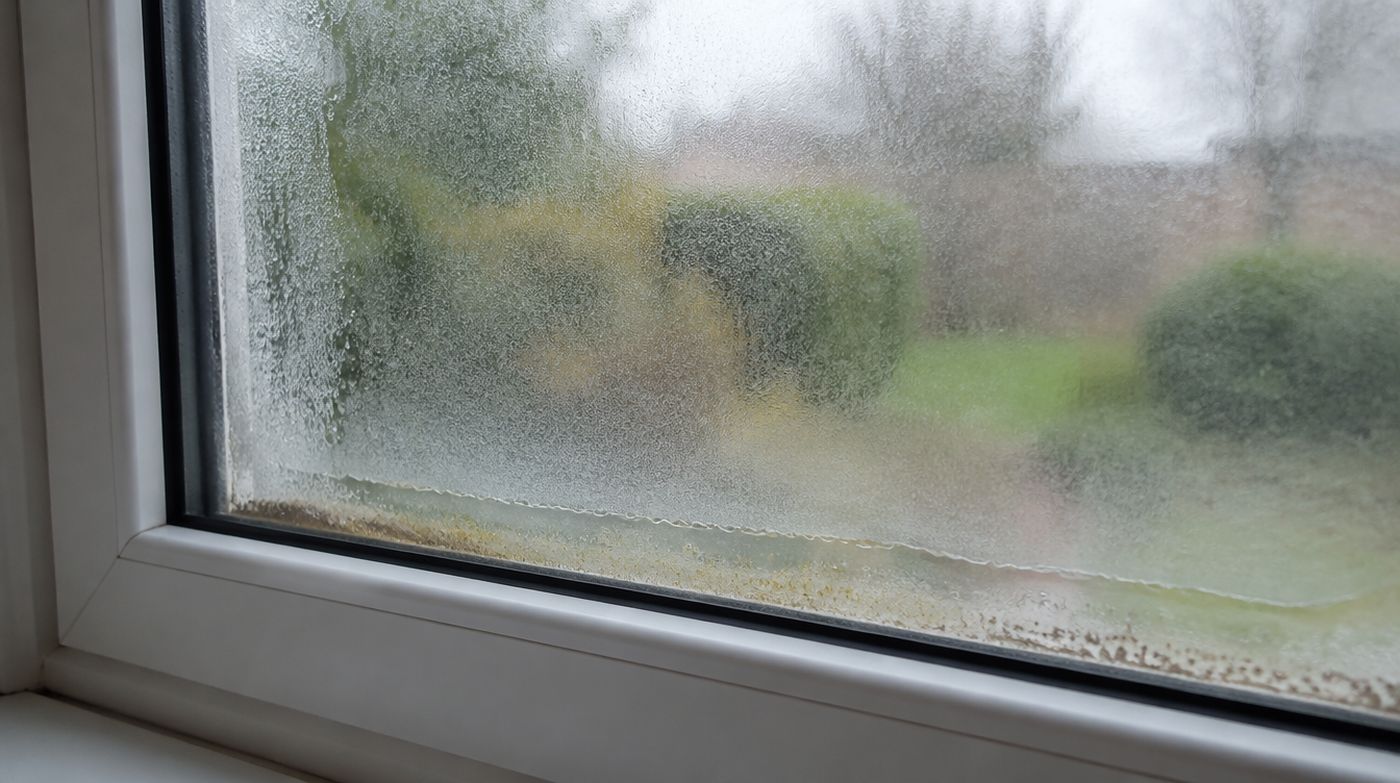
The 1980s and 1990s uPVC wave across the outer boroughs
Croydon, Bromley, Havering, Hillingdon, Enfield and Bexley took the first big generation of uPVC replacement windows, and that work is now thirty to forty years old. The pattern is consistent. The frames are often perfectly serviceable, if a little chalky, while the units inside them are at the end of their seal life more or less all at once. Overall thicknesses of 20mm or 24mm, bright aluminium spacers, two panes of clear float glass, no coating, no argon worth mentioning. Wide front bays and large fixed lights over a metre and a half across, which were ambitious for the spacer technology of the time.
The practical news is good. These are the easiest houses in London to work on. Most windows can be reached from the ground or from a low tower, most have a driveway or a hardstanding so the van parks within a few metres of the door, and the frames are internally beaded, which means units can be changed from inside without any external access at all. If your street was built in one go and re-glazed in one go, the units next door are the same age as yours, and neighbours quite often share a survey visit.
Central and inner north London: conservation areas, timber and sash windows
Islington, Camden, Hackney and Westminster, along with Richmond and Greenwich further out, are a completely different job. Here the housing stock is Victorian and Edwardian timber: box sash windows and timber casements, often in a conservation area, sometimes listed. The rebates were cut for 4mm single glass bedded in linseed putty, so the depth available is frequently between 10mm and 16mm. A standard 28mm unit is not going anywhere near them.
The answer is a slim sealed unit, commonly 10mm to 14mm overall, with a narrow cavity, a low emissivity inner pane and a warm edge spacer, sometimes with krypton rather than argon because a very narrow cavity performs better with it. Be realistic about the result. A slim unit cannot perform like a 28mm one and we will not pretend otherwise. What it does deliver is a warmer glass surface, much less condensation on the inside face, a noticeable drop in draught and road noise, and the original window kept. For most owners in Islington or Camden, those are the reasons to do it, not a headline U-value.
Two details decide whether a slim unit job goes well in a sash window. First, putty is not a glazing method for a sealed unit: the rebate is converted to a timber bead with an appropriate bedding compound, so the unit edge is supported and can drain. Second, weight. A sash that was balanced for a single pane will not stay up with two panes in it. The counterweights have to be changed or the spiral balances replaced, and anyone who glazes a sash without touching the weights has left you with a window that slides shut on its own. In a conservation area we also match the existing glazing bar arrangement closely, and on a listed building we will not start until the owner confirms that consent for altering the glazing is in place.
Flats, mansion blocks and anything above the first floor
The mansion blocks of Maida Vale, St John's Wood, Marylebone and Kensington, the purpose-built 1930s blocks across north London, and the later council-built blocks everywhere all pose the same question: how does the glass get to the window and the old unit get out. Scaffolding is not the answer. For one or two units the cost is out of proportion, the licence takes weeks, and most freeholders will not entertain it anyway.
So the work has to be done from inside, and whether it can be depends entirely on whether the frame is internally or externally beaded. Internally beaded means the unit comes out into the room and we need no external access at all. Externally beaded means the beads are on the outside face, and above the first floor that leaves a powered access platform, a licence to stand it on the road, or sometimes no practical answer. We check this at survey and tell you before you commit to anything, because it is the single biggest variable in the price of a flat job.
Then there is simply getting the glass up there. Glass weighs about 2.5 kilograms per square metre for every millimetre of thickness, so a unit 1.2 metres by 1.5 metres in 4mm over 4mm is around 36 kilograms before anyone has got their hands around the edges. That is a two person carry up a stair, and a long unit will not turn the half landing of a 1930s block however strong the two people are. We measure the route: lift car dimensions, the diagonal of the lift door, the dogleg at each landing, door widths and the turn into the flat. Occasionally the honest conclusion is that one large glazed area has to become two units with a transom, and it is much better to know that at survey than on fitting day.
Building management adds its own layer. Many blocks want notice, a method statement and a copy of our public liability cover before anyone comes through the front door, some issue works permits, and a good number restrict deliveries and noisy work to set hours or ban them at weekends entirely. Goods lifts get booked. Porters need telling. We would rather spend a week on that paperwork than turn up with a van of glass and be refused entry, so tell us at the first call if your building has a managing agent.
Freeholder and estate consent for changing how the glazing looks
In a flat the windows are very often the freeholder's responsibility under the lease, even when the leaseholder is the one paying to fix them, and the appearance of the elevation is usually protected. That matters more on sealed units than people assume, because several of the choices are visible from the street. Swapping a bright aluminium spacer for a black warm edge one changes the line around the glass. Losing a Georgian bar layout, or matching an obscure pattern with the nearest current equivalent rather than the original, changes the front of a block that was uniform.
Check the lease and ask the managing agent before you order. Local authority estates across Southwark, Lambeth, Hackney and Brent frequently have a standing rule on window appearance, and it is enforced long after the work is done. Our default is to match what is there, which is also why we photograph and record the existing pattern, bar spacing and spacer colour at survey rather than making a decision for you.
Terraced streets, side access and getting glass to the back of the house
The Victorian and Edwardian terraces of Walthamstow, Leyton, Tottenham, Peckham, Brixton, Clapham and Fulham generally have no side access at all, which means a unit for a rear window or a patio door travels through the front door, down the hall, past the stairs and through the kitchen. A two metre sliding patio unit through a narrow hall with a dogleg stair is a decision, not an assumption.
We walk the route at survey and record the numbers: the front door opening, the narrowest point of the hall, the turn at the foot of the stairs, any step down into a rear extension, and the clearance through the kitchen. Floors get protected. Where the route genuinely will not take the unit, a crane or a roof lift is not realistic for domestic glass, and the honest answer is to split the glazed area differently or accept a smaller pane configuration. Better to hear that at quotation stage than to watch a fitter try to flex a sealed unit, which is the one thing glass will not forgive.
Parking, permits and a van carrying glass
A van with an external glass rack cannot park where a car can, and we need to be close to the door. Carrying a forty kilogram unit a hundred metres down a terraced street with cars parked both sides is how glass gets broken and backs get hurt. In a controlled parking zone we either pay and display and put it on the quote, or we ask you for a visitor permit, which is usually the cheaper route for both of us.
Red routes are a harder constraint. On the main roads out through Shepherd's Bush, Holloway, Streatham and Stratford there is no stopping at all in the restricted hours, so we schedule those jobs off peak rather than risk a penalty we would have to pass on. A loading bay gives us enough time to change a single unit but not to work through a whole bay window. For a full house or a multi-unit job in a tight inner London street, a suspended bay from the borough is worth arranging, and it takes several working days to get, so it is a conversation at survey rather than the day before. Central London jobs inside the congestion charge zone carry that charge, and we show it on the quotation rather than hiding it in the glass price. Gated mews and estate roads need the code or a fob arranged in advance, and private estate roads in places like Dulwich and Hampstead sometimes need the estate office told as well.
How we route surveys across London
Surveys are free and stay free because we group them by area. North west, west and central London are usually within a few days. South east, far east and the outer southern boroughs we batch, so there may be a short wait for a date that suits both of us. Measuring needs daylight and access to the inside of every window and ideally the outside as well, so clear enough space to reach the glass, and tell us in advance if a window sits behind a fitted blind, a permanent shutter or a fixed secondary glazing panel. Those can be worked around, but only if we know before the surveyor arrives.
Get a price for your replacement units
Tell us roughly how many windows have misted and we will give you a price. Several units on one visit works out cheaper per window.